Thursday, June 07, 2007

Sony's U.S. video-game unit cuts jobs


TOKYO - Sony's U.S. video-game unit is cutting jobs to become more competitive, the company said Thursday, as the PlayStation 3 machine struggles against rival offerings from Microsoft and Nintendo.


Numbers and other details aren't being disclosed about the employee reductions at Sony Computer Entertainment Inc. in the U.S., which began Wednesday, said spokeswoman Sayoka Henmi in Tokyo.

The job cuts in the U.S. follow those in Europe in April, but no cuts are planned for Japan, she said.


"The goal is to reform the organization," she said.


Sony Corp (NYSE:SNE - news). officials have said that changes are in order to adjust to the needs of the industry, as people increasingly use their machines for linking to the Internet, watching video, listening to music or looking at photos, not just playing games.

The PlayStation 3, which competes against Microsoft Corp.'s
Xbox 360 and Nintendo Co.'s Wii, went on sale in November in Japan and the U.S., and in March in Europe.

Tokyo-based Sony shipped 5.5 million PS3 machines in the fiscal year through March 31, fewer than the 6 million the company had targeted.

Nintendo, the Kyoto-based maker of Super Mario and Pokemon games and Game Boy Advance machines, shipped 5.84 million Wii consoles worldwide during the same period. The Wii, which went on sale late last year worldwide, has done very well, winning over the elderly and other newcomers to games with a wandlike remote-control that can be used for fishing, tennis and other easy-to-play games.

Sony isn't expecting to post a profit in its game business until the fiscal year ending March 2009.

U.S. software company Microsoft is expecting to have sold 12 million Xbox 360 consoles by June. The machine went on sale in 2005.

In recent years, Sony has been restructuring and playing catch-up to improve profit in its core electronics division. But the hefty startup costs for the PS3 are weighing heavily on its revival efforts.

Saturday, May 26, 2007

Sony develops film-thin, bending display


TOKYO - In the race for ever-thinner displays for TVs, cell phones and other gadgets, Sony may have developed one to beat them all — a razor-thin display that bends like paper while showing full-color video.

Sony Corp (NYSE:SNE - news). released video of the new 2.5-inch display Friday. In it, a hand squeezes a display that is 0.3 millimeters, or 0.01 inch, thick. The display shows color images of a bicyclist stuntman and a picturesque lake.

Although flat-panel TVs are getting slimmer, a display that's so thin it bends in a human hand marks a breakthrough.

Sony said it has yet to decide on commercial products using the technology.

"In the future, it could get wrapped around a lamppost or a person's wrist, even worn as clothing," said Sony spokesman Chisato Kitsukawa. "Perhaps it can be put up like wallpaper."


Tatsuo Mori, an engineering and computer science professor at Nagoya University, said some hurdles remained, including making the display bigger, ensuring durability and cutting costs.

But he said the display's pliancy is extremely difficult to imitate with liquid crystal displays and plasma display panels — the two main display technologies now on the market.

"To come up with a flexible screen at that image quality is groundbreaking," Mori said. "You can drop it, and it won't break because it's as thin as paper."

The new display combines two technologies: Sony's organic thin film transistor, which is required to make flexible displays, and organic electroluminescent display.

Other companies, including LG. Philips LCD Co. and Seiko Epson Corp., are also working on a different kind of "electronic paper" technology, but Sony said the organic electroluminescent display delivers better color images and is more suited for video.

Sony President Ryoji Chubachi has said a film-like display is a major technology his company is working on to boost its status as a technological powerhouse.

In a meeting with reporters more than a year ago, Chubachi boasted Sony was working on a technology for displays so thin it could be rolled up like paper. He had predicted that the world would stand up and take notice.

Win a Nintendo Wii from CinemaNow!

Some analysts have said Sony, which makes Walkman portable players and PlayStation 3 video game machines, had fallen behind rivals in flat-panel technology, including Samsung Electronics Co. of
South Korea and Sharp Corp. of Japan.

But Sony has been marking a turnaround under Chubachi and Chief Executive Howard Stringer, the first foreigner to head Sony, by reducing jobs, shuttering unprofitable businesses and strengthening its flat TV offerings.

Saturday, May 05, 2007

Analysts cynical of Microsoft-Yahoo deal


NEW YORK - Speculation about a possible Microsoft-Yahoo tie-up met with skepticism Friday from analysts as reports that the deal was already dead began to surface. The reported takeover talks that sent shares of Yahoo Inc. (Nasdaq:YHOO - news) up by 10 percent Friday were no longer taking place, the Wall Street Journal said in an online article citing sources familiar with the negotiations.

Yahoo Inc. shares surged following published reports Friday that Microsoft Corp. had resumed its pursuit of Yahoo to better compete with Web search and advertising leader Google Inc.

Both companies declined comment on the reports.

David Hallerman, a senior analyst at the research group eMarketer, said he saw many cultural problems and few strategic benefits with a Microsoft-Yahoo combination.

"There's too much overlap between Microsoft and Yahoo, and to try to merge the company cultures of two large companies like that in general is hard," Hallerman said.

Hallerman said Microsoft would be better off buying an ad network to beef up its own operations, the same way Time Warner Inc.'s AOL has seen its advertising revenue grow following the acquisition of Advertising.com's technology and sales force.

Yahoo, meanwhile, would have lost the flexibility it needs to compete if it became one division within a larger company like Microsoft, he said.


Yahoo! Personals


Industry analyst Matt Rosoff with Directions on Microsoft in Kirkland, Wash., said the huge takeover was unlikely, noting that Yahoo would duplicate services Microsoft's MSN already provides, such as instant messaging and e-mail.

It is possible, Rosoff added, that Microsoft and Yahoo might pursue a deal involving only online search advertising. Hallerman said he could see at most a spinoff of Microsoft's MSN online division to be run by Yahoo.

Microsoft clearly needs to make some kind of bold move because it remains a distant third in the lucrative online search market despite investing heavily in an attempt to gain ground on Google and Yahoo, said Ryan Jacob, who runs an Internet fund specializing in Internet stocks.

To make matters worse for Microsoft, the personal computer software empire that accounts for most of its profits is being increasingly threatened by so-called "open source" alternatives as well as free online programs being offered by Google and others.

"Microsoft is at a crossroads," Jacob said.

Yahoo also has reached a critical juncture after sputtering through much of 2006 while Google's search engine continued to fire on all cylinders. The troubles weighed on its stock, price which plunged 35 percent last year to wipe out about $20 billion in shareholder wealth.

An improved advertising format, dubbed "Panama," raised hopes for a quick turnaround earlier this year, but those evaporated last month when Yahoo reported an 11 percent decline in its first-quarter profit. Analysts say Yahoo's earnings better pick up in the second half of this year or Chairman Terry Semel might lose his job as chief executive.

A combined Microsoft-Yahoo still wouldn't be as large as Google. In March, Google commanded a 48 percent share of the U.S. search market, trailed by Yahoo at 27.5 percent and Microsoft at 11 percent, according to the latest data from comScore Media Metrix.

Microsoft is feeling increasing pressure to compete with Google, which plans to beef up its portfolio with a $3.1 billion purchase of online advertising company DoubleClick Inc. Both Microsoft and Yahoo also expressed interest in buying DoubleClick before being trumped by Google.

Microsoft currently trails both Yahoo and Google in the lucrative and growing business of Web search, even as Google increases its development of Web-based software that directly competes with Microsoft's lucrative Office suite.

Microsoft and Yahoo each considered buying a stake in AOL in late 2005, but Google ultimately won a search advertising deal and agreed to pay $1 billion for a 5 percent stake in AOL.

Earlier this week, Yahoo said it would buy 80 percent of advertising exchange Right Media for $680 million, increasing its stake in that company to full control.

Yahoo shares surged $2.80, or 9.9 percent, to $30.98 on Friday, while shares of Microsoft fell 41 cents to $30.56.

Saturday, March 10, 2007

Solar technology gets White House boost


BOSTON - A company trying to harness energy from sunlight and interior light to wirelessly power everything from cell phones to signboards now has financial backing from the White House.

President Bush's program to help solar energy compete with conventional electricity sources will help fund Konarka Technologies' development of flexible plastic solar cell strips — material that could be embedded into the casings of laptop computers and even woven into power-producing clothing to energize digital media players or other electronics.

The technology, which received its first
Pentagon funding three years ago, offers a lightweight, flexible alternative to conventional rigid photovoltaic cells on glass panels.

Energy Secretary
Samuel Bodman is scheduled Thursday afternoon to tour Konarka's headquarters in a former textile mill in Lowell, where he's expected to announce funding from Bush's Solar America Initiative.


The award amount and other details were to be announced in a news conference at Konarka, a six-year-old private company that has attracted nearly $60 million in venture capital funding.

Konarka's nearly $10 million in grant money to date from U.S. and European governments includes funding from the Pentagon to supply lightweight portable battery chargers and material for tents to draw power from sunlight.

Chief Executive Howard Berke said the new White House support is a milestone for Konarka.

The first commercial product using Konarka's technology isn't expected to hit the market until next year, and the company isn't saying what that product might be. Konarka expects to provide prototypes in the second half of this year to commercial partners that would bring the technology to market.

Konarka's approach "is potentially a great breakthrough technology, but like all breakthroughs, they don't happen instantaneously," Berke said in a phone interview.

Observers say Konarka has a good chance of becoming a leader in solar power, an industry enjoying a recent surge in initial public stock offerings by startup companies as well as growing investments from traditional energy companies — for example, one of Konarka's financial backers is Chevron Corp.

Watch Big Brother All Stars 24/7 on SuperPass


Konarka's development of plastic solar cell strips that can be manufactured like rolls of photographic film "has the promise of becoming a low-cost manufacturing technique," said Jeffrey Bencik, a Jefferies & Co. analyst who follows the solar industry. "Some of their laboratory production has worked as advertised. But can they mass-produce it and get the same result? That's the biggest question."

Among developers of solar technology for small-scale uses, Konarka is "definitely doing the best job at developing what ultimately will have to be a mass-manufactured material," said Dan Nocera, a Massachusetts Institute of Technology chemistry professor.

However, Nocera said it remains to be seen whether Konarka's so-called "Power Plastic" is sufficiently chemically stable to convert energy efficiently both when light is dim and when it's bright.

Konarka, which takes its name from an ancient temple in India dedicated to the sun god Surya, was founded by Berke and Alan Heeger, who shared the 2000 Nobel Chemistry prize for showing that certain plastics can be made to conduct electricity.

The discovery about polymers — long considered to be useful only as electrical insulators — led to the development of new types of plastics to create flexible and lightweight alternatives to traditional solar cells on heavy glass panels.

Konarka developed low-cost plastics that could be used as the top and bottom surfaces of the photovoltaic cell. The 50-employee company says it has more than 280 patents and patent applications for materials, manufacturing and other processes and devices.

The company says its solar cells are efficient across a much broader spectrum of light than traditional cells, allowing them to draw energy from both the sun and indoor lighting.

Konarka says its material is lightweight and flexible so that it can be colored, patterned and cut to fit almost any device. The firm envisions embedding its material in cell phones, laptops and toys to provide power on the go. Clothing could be woven with the material to supply power for handheld electronics, and signboards, traffic lights and rooftops could be fitted with solar strips.

Berke foresees wide use of such technology in the developing world and areas off the electrical grid.

To that end, Berke said Konarka has held confidential discussions with the manufacturer of an inexpensive portable computer developed for the nonprofit One Laptop Per Child project, which seeks to provide computers to young students in the developing world. The project's current design features a hand crank for charging batteries.

"In the developing world, great demand exists for off-the-grid support of electronic devices," Berke said.

Gate.com Hosting Banner

Saturday, February 24, 2007

Security scanner can see through clothes


PHOENIX - Sky Harbor International Airport became the country's first to begin testing a controversial new federal screening system that takes X-rays of passenger's bodies in an effort to find concealed explosives and other weapons.
The Phoenix airport started testing the new technology on Friday. It can see through people's clothes and show the body's contours with blush-inducing clarity.

Critics have said the high-resolution images created by the "backscatter" technology are too invasive. But the Transportation Security Administration adjusted the equipment to make the image look something like a line drawing, while still detecting concealed weapons.


Broadband Essentials by RealNetworks


During testing, the machine will be used only as a backup screening measure. Passengers who fail the standard screening with a metal detector will be able to choose between the new device or a pat-down search.

"It's 100 percent voluntary, so if the passenger doesn't feel comfortable with it, the passenger doesn't have to go through it,"
TSA spokesman Nico Melendez said.

Passengers selected for screening by the device are asked to stand in front of the closet-size X-ray unit with the palms of their hands facing out. Then they must turn around for a second screening from behind. The procedure takes about a minute.

"It seems faster. I'm not uncomfortable with it," said Kelsi Dunbar, 25, of Seattle, who chose the machine. "I trust TSA, and I trust that they are definitely trying to make things go quickly and smoothly in the airport.


Gate.com Hosting Banner


But one expert said the machine's altered image is ineffective, while the clear picture is an invasion of privacy.

"The more obscure they make the image, the more obscure the contraband, weapons and explosives," said Barry Steinhardt, director of the Technology and Liberty Project at the ACLU in Washington, D.C. "The graphic image is a strip-search. You shouldn't have to be strip-searched to get on an airplane. Millions of Americans would regard them as pornographic."

The machine will be tested for up to 90 days at a single checkpoint at Sky Harbor International Airport's largest terminal, which hosts US Airways and Southwest Airlines, the two busiest airlines in Phoenix.

The technology could be left in place after the trial period, and the TSA hopes to roll out similar machines at the Los Angeles airport and New York's Kennedy Airport by the end of the year.

The security officer who works with the passenger going through the screening will never see the images the machine produces. The pictures will be viewed by another officer about 50 feet away who will not see the passenger, the TSA said.


Click Here


The machine cannot store the images or transmit them and "once we're done screening the passenger, the image is gone forever," Melendez said.

He said the device at Sky Harbor costs about $100,000 but is on loan from the manufacturer, American Science and Engineering Inc. of Boston.

Monday, February 12, 2007

Yahoo to unveil mobile marketing platform


SUNNYVALE, Calif. - Yahoo Inc. (Nasdaq:YHOO - news) will sell branded advertising aimed at mobile phone customers outside the United States as part of the Internet powerhouse's efforts to build other revenue sources beyond the Web.

The new mobile marketing platform to be unveiled Monday will deliver image-based ads to mobile phones in Mexico, Canada and 16 other countries in Europe, Asia and parts of South America.

The Sunnyvale-based company launched a similar advertising push in the United States in November.

Yahoo said its expanded platform for image-based ads already has lined up commitments from several major advertisers, including Intel Corp., PepsiCo Inc. and Procter & Gamble Co.

Like its other Internet rivals, Yahoo is trying to develop more ways for advertisers to reach the billions of cell phones and mobile computing devices that have become staples of modern living.

Toward that end, Yahoo also is rolling out a series of upgrades to recently introduced applications designed to make it easier to find vital information on mobile devices without clicking through as many links as conventional searches on the Web require. The new features make it easier for users to share the results with others.

Yahoo said more than 100 mobile phones now support its so-called "oneSearch" application, up from about 70 different types a little over a month ago.

FREE Trial - Trust your most precious memories to SmugMug, upload your photos today.

Saturday, February 10, 2007

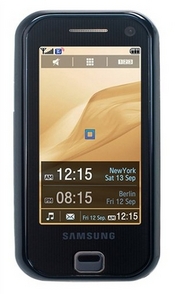
Samsung unveils iPhone-like cell phone


SEOUL, South Korea - Samsung Electronics Co. has unveiled a new mobile phone that features some of the sleek design and functions of Apple Inc.'s much-hyped iPhone.
Samsung's Ultra Smart F700 will be exhibited at next week's 3GSM World Congress, a telecommunications exhibition in Barcelona, Samsung spokeswoman Sonia Kim said Friday.

Mobile phone makers have been scrambling to match the iPhone, unveiled last month by Apple CEO
Steve Jobs. The device, which will be available starting in June, marks the iPod and
Macintosh computer maker's entry into the mobile phone business.

The ultra-thin iPhone is controlled by touching the screen a large touch screen, plays music, surfs the Internet, and runs a version of the Mac
OS X operating system, among other functions.

Samsung said the Ultra Smart F700 also has a full touch screen as well as a traditional QWERTY key pad that slides out "for users who are not yet familiar with a touch-screen-only user interface."

The phone can also access the Internet, play music, take pictures, show videos, handle e-mail and share photos, said Samsung, the world's third-largest manufacturer of mobile phone handsets.

Its third-generation (3G) technology is considerably faster than the iPhone's EDGE system, and its 5-megapixel camera outclasses the iPhone's 2-megapixel camera.

"The Ultra Smart F700 is a good example of how (the) mobile phone will evolve in the future," Choi Gee-sung, president of Samsung's Telecommunications Network Business, said in a statement Thursday.

Apple's iPhone will cost $599 for the high-end model.

Kim, the Samsung spokeswoman, said marketing plans for the Ultra Smart F700 remain unclear because the company wants to see what kind of reaction it receives at the Barcelona show.

Last month, Samsung rival LG Electronics Co. announced its own touch-screen mobile phone, the KE850 Prada.

The LG phone, produced in partnership with the Italian fashion brand, is to go on sale in late February for $780 at mobile phone dealers and Prada stores in Britain, France, Germany and Italy. It is to be launched in Asia in March.

Tuesday, January 30, 2007

Cabling Installation & Maintenance Magazine

Solutions for Premises and Campus Communication Systems Worldwide.

Cabling Installation & Maintenance provides information to industry professionals involved in the purchase, design, installation and maintenance of premises and campus-wide cabling systems.

Geographic Eligibility: USA, Canada

Publisher: PennWell
Qualify for Your Free Subscription!